Eigergletscher: the last daylight before the tunnel.
This is the final open-air stop on the route. From here, the Jungfraubahn disappears into a tunnel bored through the Eiger and doesn't resurface until Jungfraujoch itself.
A working interchange, not a viewpoint stop.
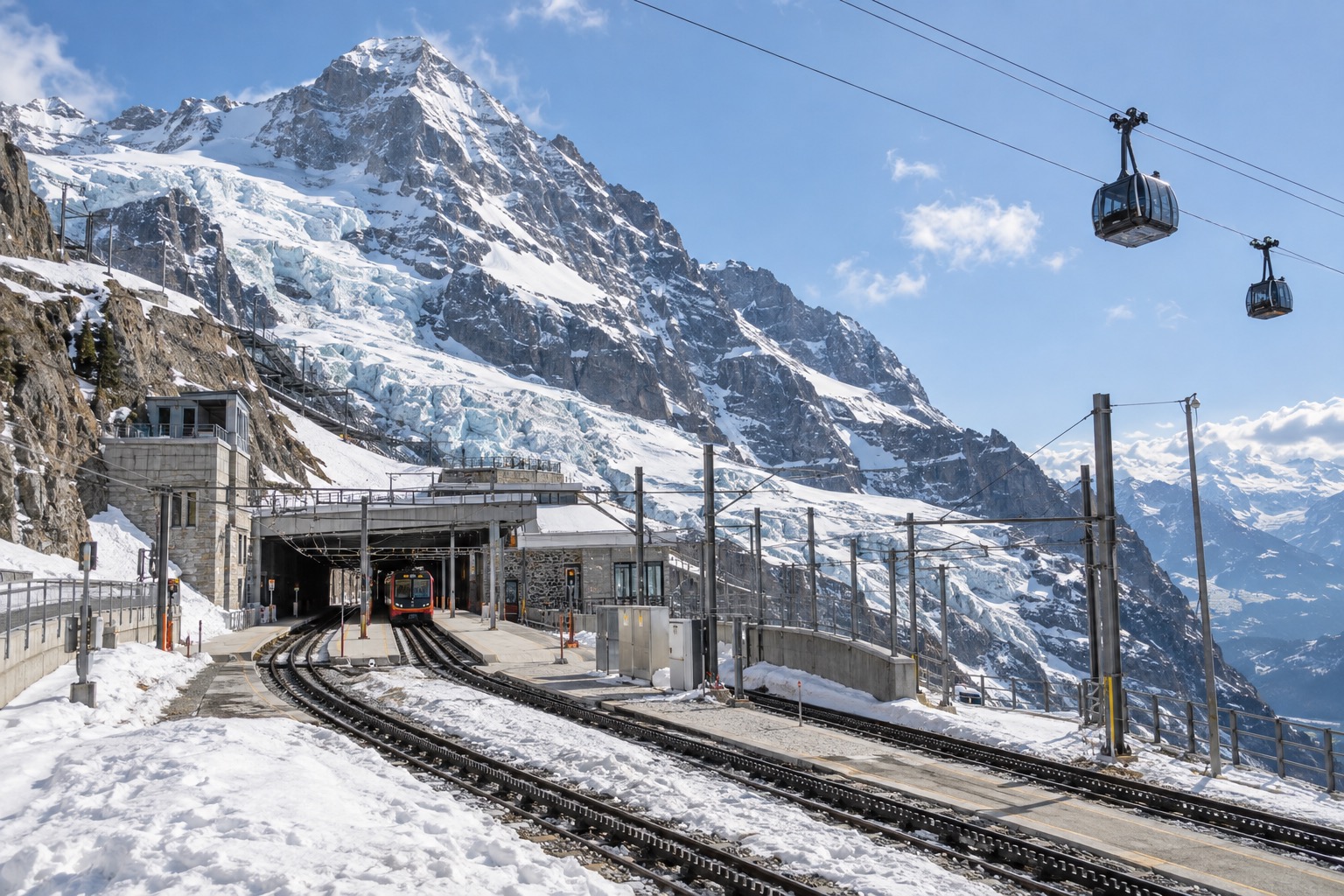
Eigergletscher takes its name from the small glacier that used to reach much closer to the station; like most alpine glaciers, it has retreated substantially up-slope in the past century. Today the stop functions mainly as an interchange: since the Eiger Express gondola opened in December 2020, this is where that direct line from Grindelwald Terminal meets the original rail line, cutting the Grindelwald route by roughly 30-47 minutes compared with the older connecting-train path through Grindelwald Grund and Kleine Scheidegg.
Why some people get off here anyway
The station sits at the actual base of the Eiger's west ridge, with a short outdoor terrace and unobstructed views back down the valley toward Grindelwald. In winter it's also a ski-lift base for part of the Kleine Scheidegg–Männlichen ski area. Outside of a gondola transfer, though, most visitors pass through without stepping off — the more dramatic stop is one station further on.
What changes once the train leaves here
Past Eigergletscher, the rack rail runs on the surface for only a short distance before entering the tunnel proper. The next roughly 20 minutes of the journey happen entirely underground, climbing through solid rock at up to a 25% gradient, with a single scheduled stop at a window gallery en route.