You don't need Valais to see the Aletsch Glacier.
The biggest glacier in the Alps flows away from the Jungfraujoch terrace itself — no separate excursion required.
Twenty kilometres of ice, seen from one terrace.
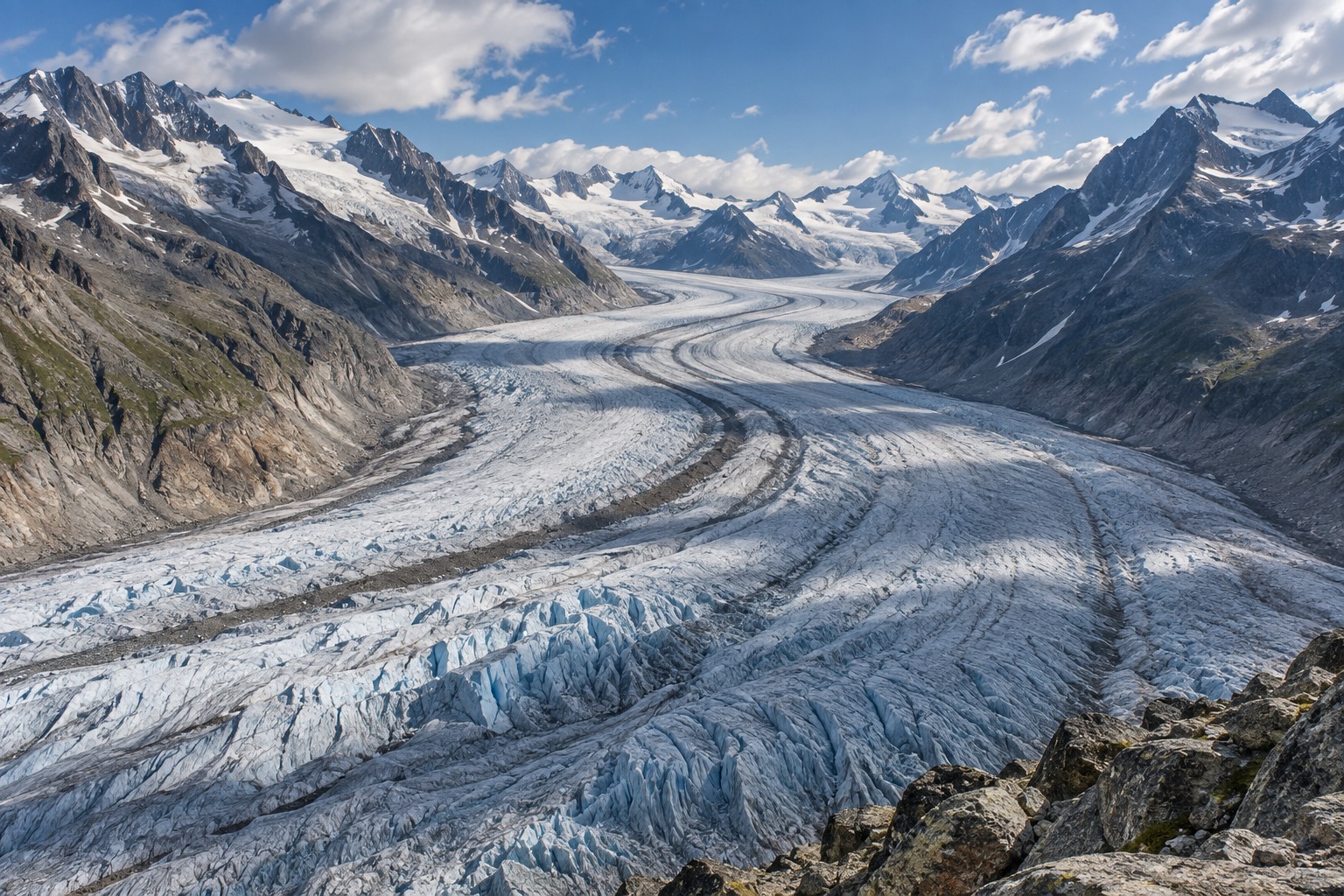
The Great Aletsch Glacier is around 20 km long and holds roughly 10 billion tonnes of ice, making it the largest glacier in the Alps by both length and volume. Most organised visits to the glacier itself — hiking its lateral moraine, or riding the cable cars at Fiescheralp or Eggishorn — approach from the Valais side of the range, a separate base entirely from Interlaken, Grindelwald, or Wengen.
The Jungfraujoch view is different: it's not a glacier excursion, it's a high vantage point that happens to look straight down the length of the ice. From the Sphinx Observatory terrace and the main Jungfraujoch platform, the glacier is visible flowing away toward the Valais, with the surrounding 4,000-metre peaks of the Jungfrau-Aletsch UNESCO World Heritage region on either side.
What you're actually looking at
The Jungfrau-Aletsch region was inscribed as a UNESCO World Heritage Site in 2001, covering roughly 824 km² across 23 municipalities in the cantons of Bern and Valais. It centres on the Eiger–Mönch–Jungfrau massif and the glacial system feeding the Aletsch. Researchers monitoring the glacier have recorded it retreating by tens of metres a year in recent decades — a visible, ongoing part of what you're looking at from the terrace, not a static landscape.
If you want to actually stand on the glacier
Jungfraujoch's groomed snow path onto the glacier plateau, toward the Mönchsjochhütte, gets you a short distance onto the Aletsch's upper firn field without mountaineering gear — weather and season permitting. For longer glacier hiking or the full moraine-trail views typically photographed from the Valais side, that's a separate trip, based around Fiesch, Bettmeralp, or Riederalp rather than anywhere on this route.