Jungfraujoch: the highest railway station in Europe.
The saddle between the Mönch and the Jungfrau, reached only by rail, and the point where the Jungfraubahn's 1912 ambition — a railway to the summit — actually stopped short of the true peak and built something else instead.
What's actually here, above ground
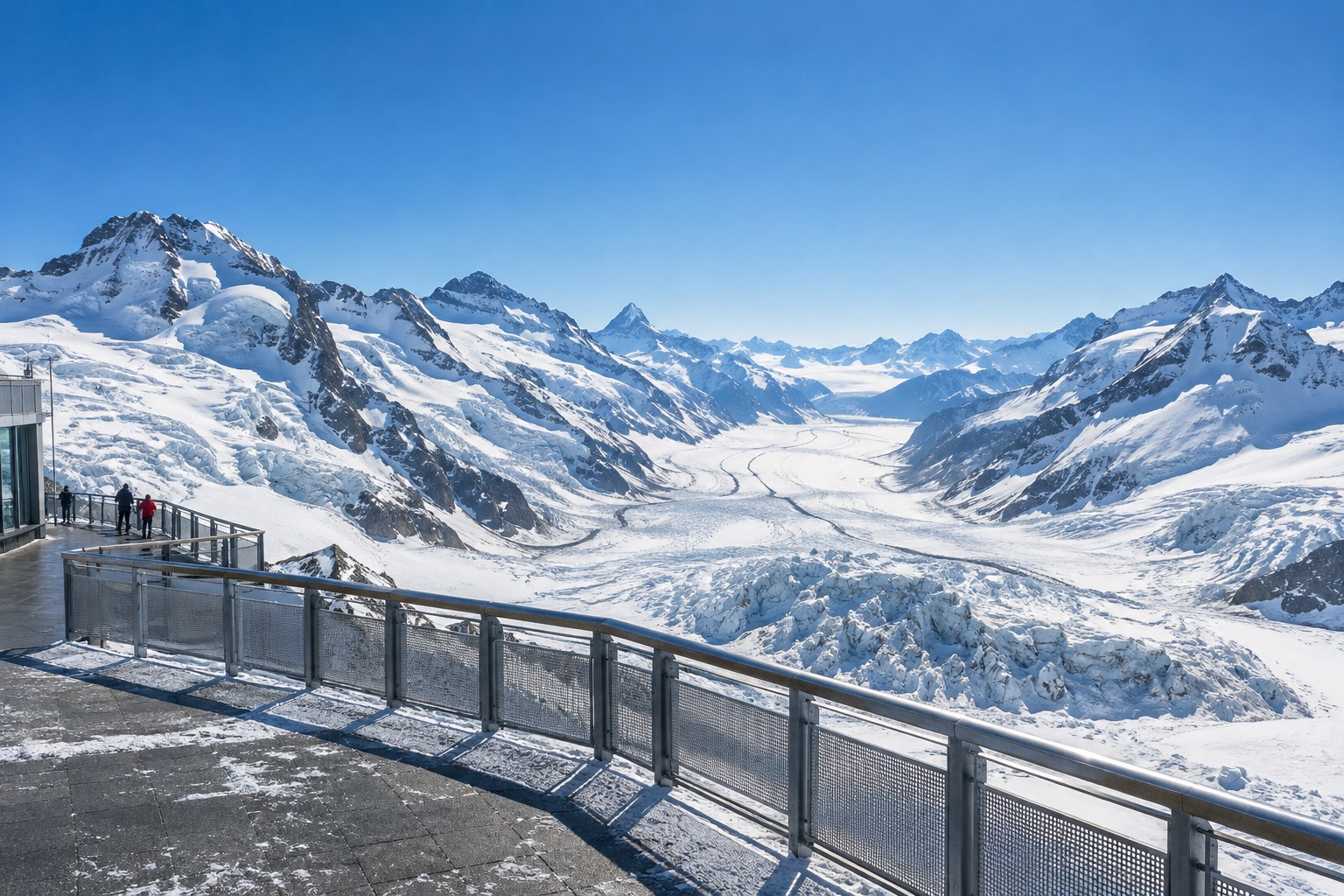
The Sphinx Observatory
A research station and public viewing terrace built on the Sphinx rock outcrop above the main station, reached by a separate high-speed lift. It's a working scientific facility — high-altitude research has been conducted here continuously since the 1930s — as well as the highest publicly accessible viewpoint on the route, with sightlines across the Aletsch Glacier and, on a clear day, into three countries.
The Ice Palace
A network of tunnels and chambers carved directly into the glacier ice beneath the station, with ice sculptures maintained year-round. It's kept at a stable sub-zero temperature by the glacier itself rather than mechanical refrigeration, and it's one of the few parts of the visit that works regardless of surface weather conditions.
The Aletsch Glacier plateau
Outside, a groomed snow path leads a short distance onto the glacier plateau itself, toward the Mönchsjochhütte — the closest most visitors get to actually standing on the Aletsch Glacier without mountaineering equipment. This is also the one part of the visit that's entirely weather-dependent: in poor visibility, it's often closed.
Why the railway stops here and not at the true summit
The Jungfrau's actual peak sits about 2.5 km further along the ridge and roughly 500 metres higher, at 4,158 m. The railway's original 1893 concept, from engineer Adolf Guyer-Zeller, planned a final lift shaft from Jungfraujoch straight up inside the Jungfrau itself to a station at the summit — never built. What exists today is the intermediate station his plan always included as a stopping point, which became the practical terminus once funding and, after Guyer-Zeller's death in 1899, momentum for the summit extension ran out.